
Just like ERSA Conference, WCTR was huge. We have started our Portugal visit four days earlier with Cascais. Enjoying life at the seaside was great. My presentation was on the first day of the conference so it was not an easy thing to shift my mind from holiday to work. But it worked fine. I followed the Intermodal Transport track mainly but also found some other interesting presentations in GIS modeling. Here (in pdf) is the book of abstracts of the WCTR 2010.
integrated transport (book)
June 2010 | 368 pages | Hardback: 978-0-415-54893-9 £75.00 | eBook: 978-0-203-85088-6 £75.00
Integrated Transport
From Policy to Practice
Moshe Givoni & David Banister
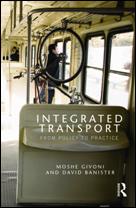 Travel is an essential part of everyday life and today most journeys are multimodal. It is the total travel experience that counts and integrated transport must reduce the inconvenience of transfers between modes. Most research and many publications on transport policy advocate sustainable transport, but the priority given to integration has been negligible. Yet integration is one of the most important means to advance sustainable transport and sustainability more generally.
While integrated transport systems are seen to be an ideal, there is a failure to make the transition from policy to practice. The authors argue that the achievement of sustainable transport is still a dream, as an integrated transport policy is a prerequisite for a sustainable transport system. It is only when the two concepts of sustainability and integration operate in the same direction and in a positive way that real progress can be made.
In this book, transportation experts from across the world have addressed the questions about what is integration, why is it so important and why is it so hard to achieve? The book provides an in-depth analysis of these issues and it aims to provide a better understanding of the subject, about what should be strived for, about what is realistic to expect, and about how to move forward towards a more integrated provision of transport infrastructure, services and management.
Selected Contents: 1. The Need for Integration in Transport Policy and Practice Section 1: The Main Issues in Integrated Transport 2. Integrated Transport Policy: A Conceptual Analysis 3. Planning For a Sustainable Travel: Integrating Spatial Planning and Transport 4. The Need for Integrated Institutions and Organisations in Transport Policy – the Case of Transport and Climate Change 5. Integrated-Transport Policy in Freight Transport 6.The Value of Reliability and its Relevance in Transport Networks 7. Appraisal of Integrated Transport Policies Section 2: Application of Integrated Transport Policy 8. Integrating Individual Travel Desires in Transport Planning: What is Too Far and What is Too Close? 9. Planning Walking Networks and Cycling Networks 10. The Role of ICT in Achieving Integrated-Transport Networks 11. Developing the Rail Network through Better Access to Railway Stations – the Need for Integration Section 3: Assessing the Potential Benefits of Integrated Transport Polices 12. Measuring the Costs and Benefits of Integrated Transport Policies and Schemes 13. A Decision Analysis Framework for Intermodal Transport: Evaluating Different Policy Measures to Stimulate the Market 14. Integrating the Railways – Key Assessment Issues 15. Assessing Iintermodal Re-Balance and Integration in Urban Transportation Planning: An Illustration on the Basis of a Sub-Lagoon Tube Plan for Venice 16. The Effects of Weather and Individual Characteristics on the Speed of Public Transport Trips: An Empirical Study Section 4: The Challenges in Achieving Integrated Transport at National, Regional and City Levels 17. Impediments to Integrative Transport Policies: Lessons from the Case of Modiin 18. Integrating Public Transport Management in France: How to Manage Gaps Between Mono-Scale Policies 19. Intermodalism in the U.S.: Issues and Prospects 20. The Pursuit of Integration: How Far and What Next?
June 2010 | 368 pages | Hardback: 978-0-415-54893-9 £75.00 | eBook: 978-0-203-85088-6 £75.00
About the Editors
Moshe Givoni is a Senior Researcher at the Transport Studies Unit (TSU) which is part of the School of Geography and the Environment (SoGE) at Oxford University. He is also a Research Fellow at Wolfson College. Before joining Oxford he was a Marie Curie Fellow at the Department of Spatial Economics, Free University Amsterdam.
David Banister is Professor of Transport Studies at the University of Oxford and Director of the Transport Studies Unit. He is also currently Director of the Environmental Change Institute in the School of Geography and the Environment at the University of Oxford. Until 2006, he was Professor of Transport Planning at University College London.
WCTR 2010 Lisbon
Deadline is over, I have submitted our paper titled “Intermodal transport in Belgium: What with the port of Zeebrugge?” and registered to the WCTR 2010 Conference.
press release of my phd
∞ Transport policy too fragmented to drive freight traffic off the road
The regional inland shipping policy and the federal railway policy in our country are insufficiently aligned to guarantee efficient intermodal transportation, in which as much use as possible is made of possible alternatives, such as transport by railway and inland shipping. This appears from the PhD study by researcher Ethem Pekin of the Vrije Universiteit Brussel, under the guidance of his promoter Prof. Dr. Cathy Macharis. In fact, the fragmentation of the policy actually encourages competition between the alternative types of transport.
∞ Versnipperd beleid fnuikt duurzame transportambities
De regionale binnenvaartpolitiek en het federale spoorbeleid zijn in België niet genoeg op elkaar afgestemd. Efficiënt intermodaal vervoer, waarbij zoveel mogelijk spoor en binnenvaart aan bod komen, is daardoor onmogelijk. Dat blijkt uit een doctoraatsstudie van Ethem Pekin van de Vrije Universiteit Brussel (VUB).
De econoom onderzocht onder begeleiding van zijn promotor prof. dr. Cathy Macharis welk stimulerend effect de politiek kan hebben op de groei van het intermodaal vervoer. “Door de beleidsversnippering dreigt de situatie op verschillende vlakken scheef te trekken”, klinkt het. “Zo verschillen de subsidies voor de binnenvaart per gewest en bovendien liggen ze lager dan de subsidies voor het spoorvervoer. Dat creëert een contraproductieve concurrentieverhouding tussen de twee alternatieve transportmodi.”
here it comes
I have done it! On April 23rd 2010, I have successfully defended my thesis. It was a nice public defense with many participants. Jury directed some interesting questions and I enjoyed answering them.
The defense was followed by a nice reception at the Complex, where Turkish mezes and drinks were served.
 Ethem Pekin, phd