

Blog
road safety
white paper 2011
Transport is a key element in generating economic progress through trade and labour forces mobility. Ensuring the distribution of goods throughout the single market from manufacturer or producer to end-user, transport contributes to the welfare of the EU and its citizens. For Europe, transport also represents an important sector of the economy, which is accounting for almost 10 percent of the EU’s gross domestic product (GDP), and employing 10 million Europeans. There has been a continuous growth in traffic in Europe, reflecting increased mobility levels, rising income levels, increased social and leisure time, and the abolishment of national barriers within Europe. In contrast to the positive effects of transport, the increase in mobility of persons and goods leads to a concern at a European level, where the European transport policy plays a pivotal role in achieving sustainable mobility in Europe.
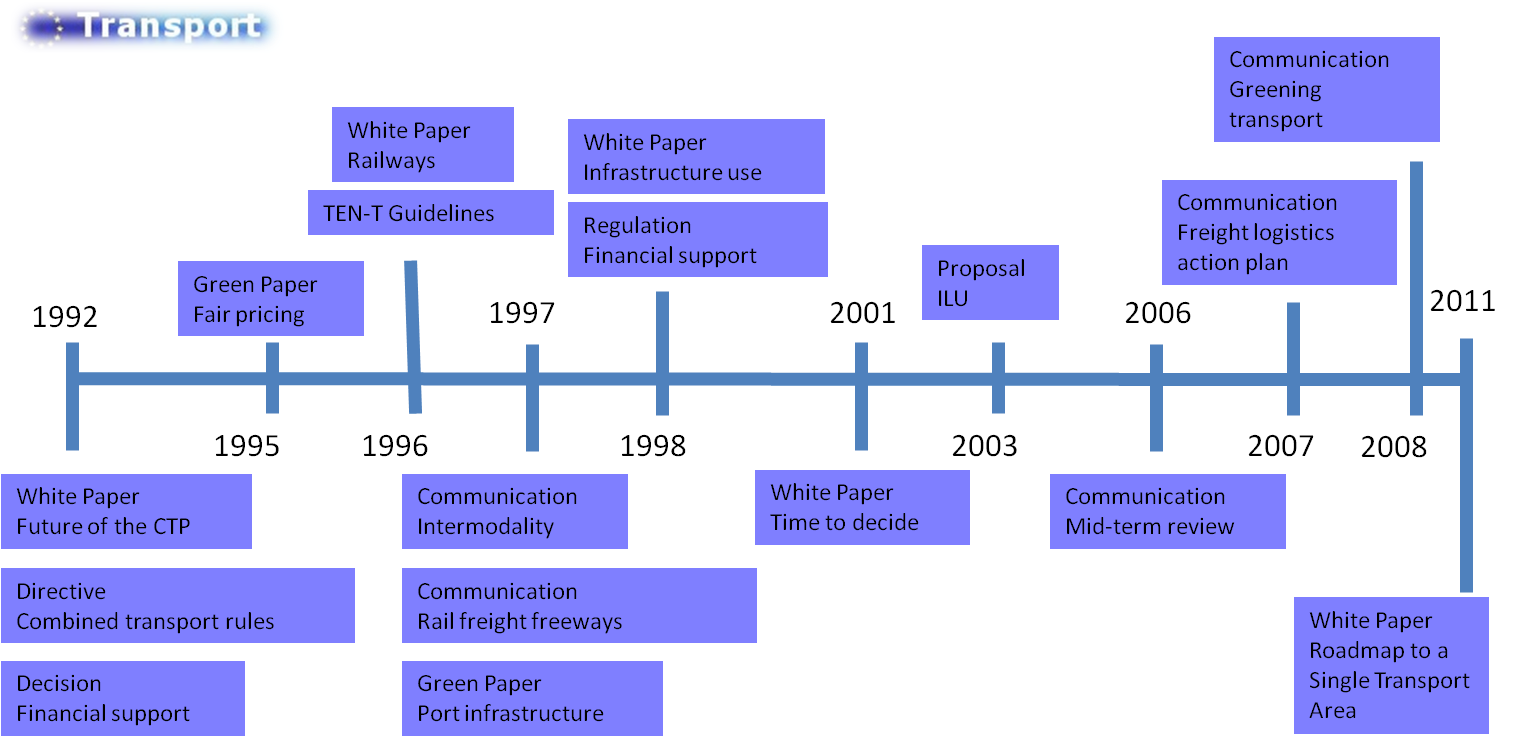
An integrated transport policy at the European level dates back to the Community’s founding Treaty of Rome (1957), where the CTP was defined as one of the Community’s priority tasks. However, the progress towards the realisation of a CTP was slow. November 1993 marks a turning point in the evolution of the CTP, when the Treaty of Maastricht came into force. Coupled with the establishment of the European Economic Area, it provided a new basis for the Community to contribute to the establishment and development of transport infrastructure (Notteboom, 2000). From six members in the 1950s to 27 in 2007, the EU promotes an integrated CTP to regulate competitiveness, cohesion and environment. Figure below depicts the evolution of the European transport policy.
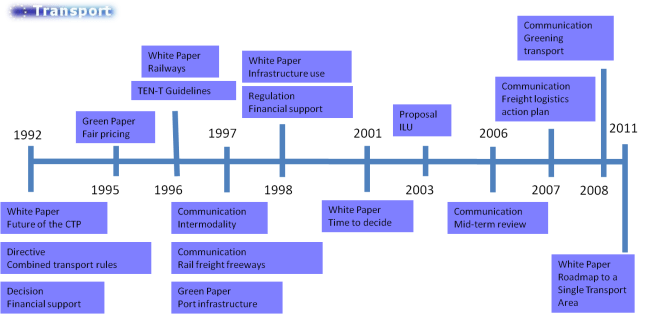
- European transport policy timeline
Pekin, 2010
Section below is quoted from my PhD thesis. On March the 28th, the European Commission adopted a roadmap of 40 concrete initiatives for the next decade to build a competitive transport system that will increase mobility, remove major barriers in key areas and fuel growth and employment. At the same time, the proposals will dramatically reduce Europe’s dependence on imported oil and cut carbon emissions in transport by 60% by 2050. By 2050, key goals will include: No more conventionally-fuelled cars in cities. 40% use of sustainable low carbon fuels in aviation; at least 40% cut in shipping emissions. A 50% shift of medium distance intercity passenger and freight journeys from road to rail and waterborne transport. All of which will contribute to a 60% cut in transport emissions by the middle of the century.
From this document I would like to highlight the reference on freight & intermodal transport:
24. Freight shipments over short and medium distances (below some 300 km) will to a considerable extent remain on trucks. It is therefore important, besides encouraging alternative transport solutions (rail, waterborne transport), to improve truck efficiency, via the development and the uptake of new engines and cleaner fuels, the use of intelligent transport systems and further measures to enhance market mechanisms.
25. In longer distances, options for road decarbonisation are more limited, and freight multimodality has to become economically attractive for shippers. Efficient co-modality is needed. The EU needs specially developed freight corridors optimised in terms of energy use and emissions, minimising environmental impacts, but also attractive for their reliability, limited congestion and low operating and administrative costs.
26. Rail, especially for freight, is sometimes seen as an unattractive mode. But examples in some Member States prove that it can offer quality service. The challenge is to ensure structural change to enable rail to compete effectively and take a significantly greater proportion of medium and long distance freight (and also passengers – see below). Considerable investment will be needed to expand or to upgrade the capacity of the rail network. New rolling stock with silent brakes and automatic couplings should gradually be introduced.
27. On the coasts, more and efficient entry points into European markets are needed,avoiding unnecessary traffic crossing Europe. Seaports have a major role as logistics centres and require efficient hinterland connections. Their development is vital to handle increased volumes of freight both by short sea shipping within the EU and with the rest of the world. Inland waterways, where unused potential exists, have to play an increasing role in particular in moving goods to the hinterland and in linking the European seas.
Under the “Ten Goals”, the European Commission is aiming to shift 30% of road freight over 300km to other modes by 2030, and more than 50% by 2050. This will be facilitated by efficient & green transport corridors. Infrastructure needs are mentioned under EU-wide multimodal TEN-T ‘core network’. By 2020, a framework for a European multimodal transport information, management and payment system will be established.
Going through the Strategy and the number of initiatives suggested I am not very optimistic about the future of European transport policy. I expected more concrete scheme and especially better linkages to other Community policies such as regional policies and the RTD.
You can download the White Paper 2011 here.
green terminal
short sea shipping 2012
International Research Conference on Short Sea Shipping
2 – 3 April 2012, Lisbon, Portugal
“Five continents – different perspectives – one objective: to move cargo by sea”
Cargo Edições Lda is pleased to announce that it will organise and host the International Research Conference on Short Sea Shipping in Lisbon, Portugal. The Conference will take place between the 2nd and the 3th of April 2012. This is a unique chance for the Country and for the international shipping community to come together and discuss the never ending short sea shipping market and short sea shipping related issues. This international forum provides the opportunity to discuss the present issues, recent trends, technological, operational and legislative developments and the challenges to be faced by short sea shipping in the future.
This discussion builds upon the body of knowledge and research carried out so far and presented in the regional meetings, at encouraging ongoing international information exchange, at strengthening the regional network, at building knowledge upon difference of opinion and experience, and fostering exchange of expertise and learning through active participation of community representatives, academia, governments, private research agencies and national research centres. In addition, it is fostered by the world economic activity and deep-sea trades activity.
On behalf of Cargo Edições Lda, I am honoured to invite the International Research Community, the Industry, International Organizations and Governments to participate in this international Conference by submitting a conceptual, empirical or theoretical research paper in the topics provided below, which broadly cover the shipping, ports and logistics industries. Participants will have the opportunity to discover a city full of historical monuments that remind us of the strength and entrepreneurship of the earlier navigators who slowly went on discovering new lands and people that gave origin to new countries, and which are part of today’s international community.
Cargo Edições Lda looks forward to seeing you in Lisbon.
Welcome to the World of Shipping.
Welcome to the International Research Conference on Short Sea Shipping.
 Ethem Pekin, phd